|
December 2, 2002
Raymond Carver letters donated to McHenry Library
By Scott Rappaport
A collection of letters from renowned American short story writer and
poet Raymond Carver has been donated to McHenry Library at UCSC.
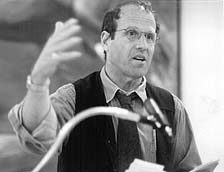 |
| David Swanger, a professor of
education and creative writing, first met Carver at UCSC when they
both arrived on campus to teach in 1971. Photo:
Courtesy David Swanger |
Valued at $23,650, the donation consists of 26 letters, notes, and
cards written to UCSC professor of education and creative writing David
Swanger between 1977 and 1984. The correspondence documents a period
in Carver’s life when he made the transition from being a relatively
obscure writer to becoming a commercially successful and well-known
author.
Carver is widely credited with revitalizing the American short story
more than anyone since Ernest Hemingway and Flannery O’Connor.
"The contents are both literary and personal," noted Swanger,
a poet and longtime friend of Carver. "They include Carver’s
reflections on my writings, thoughts about his own work, personal insights
into his life when he stopped drinking and when he met the well-known
poet Tess Gallagher, details about family relationships, jobs, and economic
success. Later letters talk more about his personal happiness and rebirth."
Swanger first met Carver at UCSC when they both arrived on campus to
teach in 1971. Carver spent three years at the university, teaching
poetry and writing classes as a visiting lecturer.
"Ray was a magnet--he attracted literary figures from around the
state," Swanger said. "Whenever a writer was in the area,
Ray would get him to do a reading at the university and we would have
a dinner. It was quite an exhilarating time and supportive environment."
According to an appraisal by Ken Lopez, a rare book dealer specializing
in 20th century literature, individual Raymond Carver letters seldom
appear on the market. But when they do, he said they can easily garner
a price ranging from $500 to $1,500, depending on the content.
"Some of the letters now seem ominous in retrospect," Swanger
said. "When he had stopped drinking and said that life couldn’t
be better, he was also not far from his death. Ray said the worst was
behind him, but we now know the worst was ahead--he died of brain cancer
at the age of 52."
A highlight of the collection is a letter dated November 30, 1980,
where Carver talks about his personal health and success, as well as
a New York Times article, a forthcoming visit with George Plimpton
and Jackie Onassis for the Paris Review, and aborted plans to
stay in Robert Frost’s house: "God, my thirties liked to have
killed me! I was glad to get out of those thirties. In so many ways
the whole time was like a strange and sometimes bad dream…some
terrible losses along the way, of course…My drinking was like a
cancer, and I was dying from it. Now I have a life again, a new life.
I could die tomorrow, heaven forbid, but it would be all right. I’ve
much to be thankful and, believe me, I am thankful for it."
Swanger noted that the Carver correspondence should be of distinct
interest to students of Carver, scholars, and biographers. He added
that he felt it was important to give the collection to UCSC.
"I have very warm feelings toward the UCSC library, and I thought
that some Carver material should stay on campus and not go elsewhere,"
he said.
"Carver became famous here," Swanger added. "Further,
there’s yet to be a biography of him, although there are collections
of pieces. I would very much like to see the UCSC library create a Carver
center, and this collection could be a cornerstone."
Return to Front Page
|